CaptureDesk
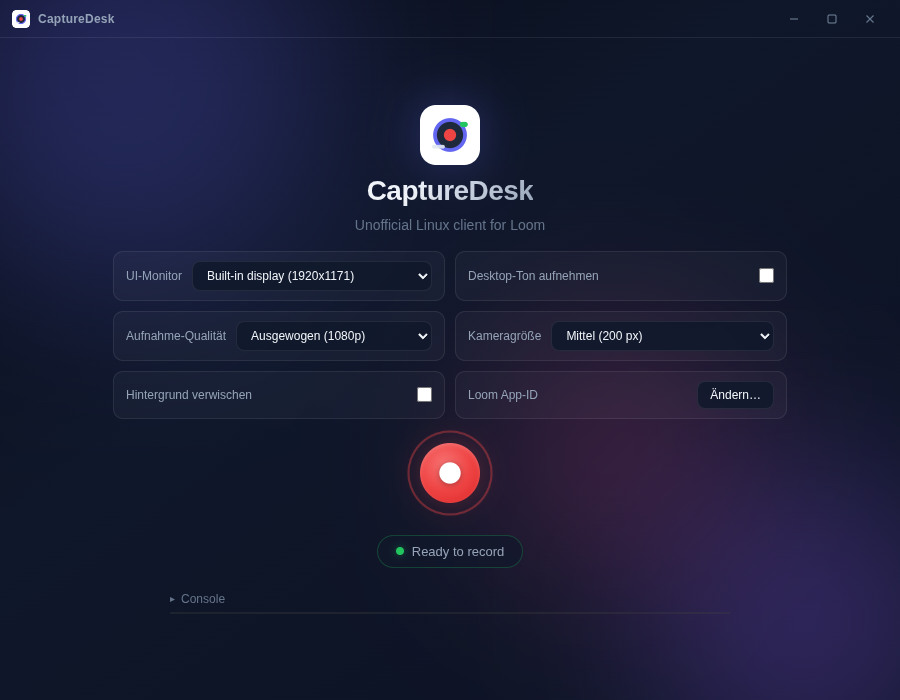
A Loom recorder for Linux. Loom has no desktop app for Linux, and recording in the browser gives you no camera bubble over other windows, no drawing on screen and no global shortcuts. CaptureDesk wraps the Loom Record SDK in an Electron app that adds them. Videos upload to Loom as usual.
github.com/PascalNehlsen/CaptureDesk, MIT for my code. Not affiliated with Loom or Atlassian. No prebuilt packages: the SDK's beta agreement does not allow redistributing it, so it is built from source. The article Bound to 127.0.0.1 and still reachable from every browser tab covers the security review in detail.
What it does
- Screen recording through the Loom SDK, uploaded to the user's Loom account
- A camera bubble above all windows: drag, scroll to resize, background blur computed locally with MediaPipe
- A drawing overlay (pen, highlighter, arrow, rectangle, eraser, undo)
- Floating controls with timer and pause, while the main window stays out of the video
- Global shortcuts for stop, pause and drawing; multi-monitor placement
.deband AppImage builds, X11 and Wayland (through XWayland, because native Wayland does not let an app position its own windows)
What it trusts, and how far
A screen recorder sees the screen, the camera and the microphone by design, and this one runs code it did not write. The last column is where each boundary is enforced.
| Code | Origin | May reach | Enforced by |
|---|---|---|---|
| My pages | local server, http://localhost:PORT | a narrow preload bridge, camera, microphone, screen | contextIsolation, sandbox, no nodeIntegration; origin check on every media permission |
| Loom Record SDK | npm, proprietary, bundled into my page | what my page can reach | nothing beyond the page itself: this is the trust I extend to Loom |
| Loom frames | https://*.loom.com | camera, microphone, screen | origin check; framing headers relaxed for Loom hostnames only |
| Popups | anything window.open asks for | the Loom session's cookies | no preload (verified), no media permissions, non-web schemes denied except mailto: |
| Local server | 127.0.0.1:PORT | pages and the public app ID | loopback bind and an exact Host allowlist (421 otherwise) |
Security review
Two passes, a day apart.
Before going public (#19):
- camera, microphone and screen capture went to any page in the Loom session, including popups, and screen capture had no prompt; now only to my pages and Loom, through one shared check
window.openhandedfile:,smb:and custom schemes toxdg-open; now onlymailto:leaves the app- the local server listened on every interface; now on
127.0.0.1 - actions pinned to commit SHAs,
permissions: contents: read,lodashoverridden past two high advisories,nodemonreplaced bynode --watch
The day after (#20):
- the loopback bind did not stop DNS rebinding: any page in the user's
browser could read
/api/loom-token. Reproduced in Chromium (Electron 44) before and after the fix:200with the app ID, then421 - dependency audit gates on high instead of critical, also on the weekly
schedule, which previously ended in
|| trueand could never fail - secret scanning reports unverified findings too
- Dependabot's npm runs had failed weekly on an unresolvable peer tree in the Loom SDK; that update is excluded with the reason written next to the rule
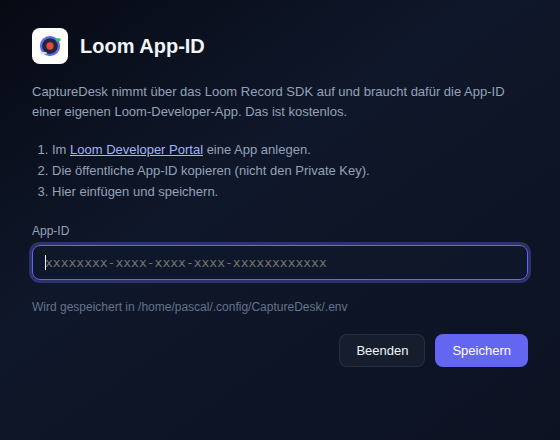
The app only ever asks for the public app ID of a Loom developer app, never the private key. That is why the rebinding finding was low impact here, and why it was still worth fixing: the server is the one component every browser tab can reach.
The deliberate trade-off
The SDK frames loom.com into a localhost page, which Loom's
X-Frame-Options and frame-ancestors forbid. CaptureDesk removes those
headers for Loom hostnames only, inside its own Electron session. Nothing
else in Loom's CSP is changed, and no ordinary browser shares that session.
Pipeline
- CI: syntax checks for the JavaScript, shell and Python parts,
npm audit --audit-level=high - Security workflow on push, pull request and weekly: TruffleHog over the full history (all result types), blocking audit on the schedule, full advisory list as information
- Dependabot weekly for npm and GitHub Actions, actions pinned by SHA
Known gaps
- No automated test for the
Hostcheck or the permission rules yet; CI only checks syntax. - IPC handlers do not verify the sending frame. Only my own windows have the preload today, so this is a consequence, not a rule.
- Popups share the Loom session's cookies, which sign-in needs.
- Plain
http://popups are still allowed. - The Loom SDK is closed source running in my renderer. The controls above limit what it can reach; they do not make it auditable.