Bound to 127.0.0.1 and still reachable from every browser tab

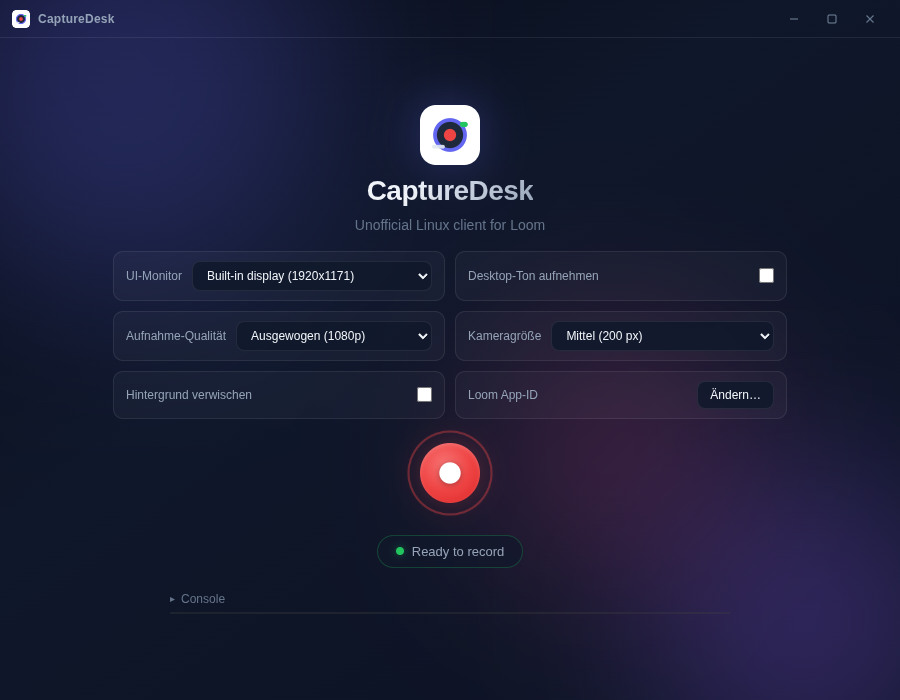
On 5 October I made CaptureDesk public. It is a small Electron app: Loom has no desktop client for Linux, and recording in the browser gives you no camera bubble that floats over other windows, no drawing on screen and no global shortcuts. CaptureDesk wraps Loom's Record SDK and adds them.
Before flipping the repository to public, I did a hardening pass and found three real problems. One of the fixes was binding the app's local server to 127.0.0.1 instead of every interface.
The next day I read it again and found that the server still answered any web page open in the user's browser. Binding to loopback had not closed that door. It had only made it narrower.
What a recorder actually trusts
A screen recorder is about the worst place to be casual about trust. It can see your screen, your camera and your microphone by design. And this one does not just run my code. It runs:
| Code | Where it comes from | What it can reach |
|---|---|---|
| My pages (main window, camera bubble) | a local Express server on localhost | the preload bridge, camera, microphone, screen |
| The Loom Record SDK | npm, proprietary, bundled into my page | everything my page can reach |
| Loom's own frames | loom.com, loaded into my page | camera, microphone, screen, cookies of the Loom session |
| Popups (Loom sign-in, OAuth pages) | whatever window.open asks for | the Loom session's cookies |
| The local server | 127.0.0.1:8080 | the app ID, the pages |
| The operating system | shell.openExternal, i.e. xdg-open | any registered URL handler |
The local server exists for a boring reason. Background blur runs MediaPipe's WebAssembly runtime, and fetching .wasm from a file:// origin is blocked. localhost over HTTP counts as a secure context, so getUserMedia keeps working. It serves the pages and one endpoint, /api/loom-token, which hands the renderer the Loom app ID.
The pass before going public
Three findings, each one a few lines of code, each one something a reviewer would have found in minutes.
The screen went to any popup, without a prompt. The permission handler granted camera, microphone and screen capture to every request in the Loom session. Sign-in pages and anything else opened through window.open live in that session. Screen capture does not show a picker here (the app picks the monitor itself), so a popup asking for the screen simply got it. Now the decision depends on who is asking:
// Our own pages (served from the local server) and Loom.
function isTrustedMediaOrigin(rawUrl) {
  if (!rawUrl) return false;
  try {
    const { protocol, hostname, port } = new URL(rawUrl);
    if (protocol === "http:" && (hostname === "localhost" || hostname === "127.0.0.1")) {
      return Number(port) === PORT;
    }
    return protocol === "https:" && isLoomUrl(rawUrl);
  } catch {
    return false;
  }
}
It guards the permission request handler, the permission check handler and the display media handler. Three entry points, one rule, so they cannot drift apart.
window.open handed any scheme to the desktop. Non-web URLs went straight to shell.openExternal, which on Linux means xdg-open. A page in the Loom session could ask for file:, smb: or any custom scheme a local application has registered. Now only mailto: leaves the app; everything else is logged and denied.
The server listened on every interface. app.listen(PORT) without a host binds to all of them, so anyone on the same café Wi-Fi could fetch the pages and the app ID. The fix was one argument: "127.0.0.1".
I committed those with the message "harden the app and the pipeline before going public", and that is where my confidence came from. It was the third fix that turned out to be incomplete.
What was already right, and checked rather than assumed
Every window runs with contextIsolation: true, nodeIntegration: false and sandbox: true. The preload script exposes a narrow electronAPI to my own pages: window controls, recording lifecycle, drawing tools, a handful of settings. No file system, no shell, no arbitrary IPC channel. The setup window is a local file with default-src 'none'.
One question a reviewer would ask: popups are created with my base preferences and no preload script, but do they inherit the main window's preload anyway? If they did, any page that Loom opens would get window.electronAPI. I did not want to answer that from documentation, so I reproduced the exact pattern in a minimal Electron 44 app: main window with the preload, setWindowOpenHandler returning overrideBrowserWindowOptions with the base preferences only, then window.open from the page.
main window:  typeof window.electronAPI === "object"
popup:        typeof window.electronAPI === "undefined"
Popups do not inherit it. That claim is now a test result, not a belief.
The one rule I weaken on purpose
The Loom SDK renders its UI by framing loom.com into my page. Loom's responses carry X-Frame-Options and a frame-ancestors directive that, sensibly, do not include http://localhost:8080. So the app rewrites those headers:
// Only relax embed headers for Loom-owned pages that the SDK needs to load.
browserSession.webRequest.onHeadersReceived((details, callback) => {
  if (!isLoomUrl(details.url)) {
    callback({ responseHeaders: details.responseHeaders });
    return;
  }
  const headers = { ...details.responseHeaders };
  delete headers["x-frame-options"];
  delete headers["X-Frame-Options"];
  // ...and frame-ancestors becomes "*" in any Content-Security-Policy
  callback({ responseHeaders: headers });
});
This is the part of the codebase I would expect to be asked about, so here is the reasoning. Clickjacking protection exists to stop a hostile page from framing Loom inside a browser the user trusts. Inside this app, the only page that frames anything is mine, and the rewrite happens in one Electron session that no ordinary browser shares. It is scoped by hostname to Loom, it does not touch any other response, and it does not loosen anything else in the CSP. The cost is real but bounded: if a hostile page ever got into that session's top level, Loom would frame inside it. That is the same session where the permission check now refuses anything that is not my page or Loom.
Weakening a control is sometimes the job. Doing it silently, globally, or without saying what it costs is not.
The one I missed
Binding to 127.0.0.1 decides which machine can connect. It says nothing about which web page made the request. Every page in the user's browser runs on the user's machine.
The browser's same-origin policy normally saves you: a page on attacker.example may send requests to http://127.0.0.1:8080, but it cannot read the answer. DNS rebinding removes that protection by making the attacker's own hostname point at your loopback address:

After the switch, the page and the server share an origin as far as the browser is concerned: same scheme, same hostname, same port. The script reads the response like any other.
I did not want to describe this from memory either. Chromium can be told to resolve a name to an address with --host-resolver-rules, which gives exactly the state after the rebind without running a malicious DNS server. In Electron 44, a page served as rebind.test:18081 by "the attacker", then fetch("/api/loom-token") going over the network to the real CaptureDesk server on 127.0.0.1:18081:
before the fix   200 {"appId":"00000000-0000-0000-0000-000000000000","environment":"production"}
after the fix    421
The app ID in that test is a dummy. In real use it is the ID of the user's Loom developer app.
How bad was it
Not very, in this instance, and that is worth saying plainly instead of dressing it up. The endpoint returns a Loom app ID, and an app ID is public: the setup screen tells users to copy the public ID and explicitly not the private key, which CaptureDesk never asks for.
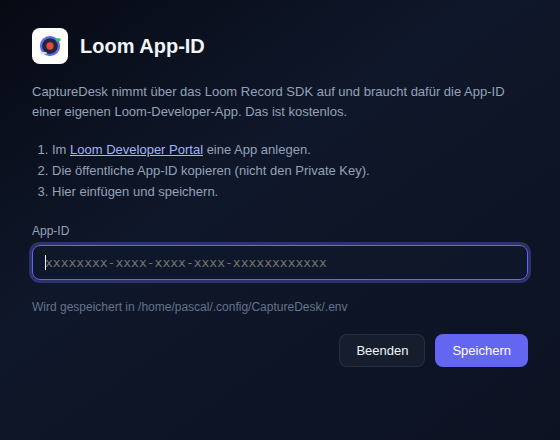
The reason it still mattered: the server is the one component that any web page can reach, and the next endpoint someone adds will not be harmless. "This happens to be public" is a property of today's payload, not of the server.
The fix
The request still carries the attacker's hostname in Host. That is the one header a rebinding page cannot change: browsers set it from the URL, and scripts are not allowed to.
// Binding to 127.0.0.1 keeps the LAN out, but not a web page in the user's
// browser: DNS rebinding points an attacker's hostname at 127.0.0.1, and the
// browser then treats this server as same-origin with that page. The request
// still carries the attacker's hostname in Host, so only our own names pass.
const ALLOWED_HOSTS = new Set([`localhost:${PORT}`, `127.0.0.1:${PORT}`]);
app.use((req, res, next) => {
  if (!ALLOWED_HOSTS.has(req.headers.host)) {
    return res.status(421).end();
  }
  return next();
});
It runs before every route, static files included. 421 Misdirected Request is the status for "this server is not the one that name refers to", which is precisely the situation. Every window in the app loads http://localhost:${PORT}, so nothing legitimate is affected:
Host | Result |
|---|---|
localhost:18080 | 200 |
127.0.0.1:18080 | 200 |
attacker.example:18080 | 421 |
localhost (no port) | 421 |
localhost.attacker.example:18080 | 421 |
The last row is why it is an exact match against a set and not a startsWith("localhost").
Why not CORS, CSP or an Origin check
CORS does not apply. After the rebind the request is same-origin; there is no cross-origin read to deny.
CSP on my pages controls what my pages may load. It has no say over who calls my server.
An Origin check is what most guidance recommends, and it is the subtle one. In the same test harness the browser sent:
same-origin GET    Origin: (none)
same-origin POST   Origin: http://rebind.test:18090
Browsers omit Origin on same-origin GET requests. A server that rejects foreign origins but lets requests without an Origin through (because curl and CLI clients do not send one) lets a rebound GET straight through. Check Origin when it is present, by all means. Check Host always.
The same hole, in every local AI tool
This is not an Electron curiosity. It is the default shape of a lot of local tooling: dev servers, debug endpoints, and increasingly MCP servers that a coding agent talks to over HTTP. The MCP specification's Streamable HTTP transport puts it first in its security warning:
Servers MUST validate the
Originheader on all incoming connections to prevent DNS rebinding attacks
followed by binding to localhost and authenticating connections. All three are right. The harness above shows why the first one needs the qualifier: that transport also uses GET to open its server-to-client stream, and a same-origin GET arrives without any Origin to validate. A local MCP server that checks Host as well as Origin does not depend on which method the attacker picks.
If you run anything on localhost that your browser could reach, the question to ask is not "is it bound to loopback?" but "what does it do with a request whose Host it does not recognise?"
The pipeline around it
The same review turned up four smaller things, all in CI rather than in the app:
- Secret scanning ran with
--only-verified. That drops every finding TruffleHog cannot confirm live: a revoked key, a key for a service without a verifier, a check that ran while the provider was down. A revoked key in a public history still tells an attacker how keys get committed. It now reports all result types; a full-history scan with all of them finds nothing, so the stricter setting started green. - The dependency audit failed only on critical. This site's own pipeline gates on high. CaptureDesk now does too, and a critical advisory for
proxy-addrpublished the night before was in the lockfile already. Express pulled it in. - The weekly scan could never fail. It ended in
npm audit || true. An advisory published between two commits would have stayed green until the next push, which in a repository this quiet can be weeks. On the schedule it now gates on high and above. I had learned that exact lesson earlier the same morning on this site's own pipeline, where a Dependabot pull request merged on a check that was a day old (the fix). - Dependabot had failed every week since at least 23 September, and nothing was looking. From 4.12 on, the Loom SDK asks for one version range of an Atlassian icon package as a peer, and for a second Atlassian package whose current releases need a newer range of the same icon package. npm cannot satisfy both. Minor and patch updates of the SDK are now excluded with that reason written next to the rule, and the alert for
uuid3.4.0 inside the SDK is closed as "vulnerable code not used": the only caller usesv4(), the advisory coversv3,v5andv6with a caller-supplied buffer, and no in-range fix exists.
Known gaps
- There is no automated test for the Host check. I verified it by hand and in the browser harness; CI only syntax-checks. That is the next thing to change, because a security control without a test is a comment.
- The IPC handlers do not check which frame sent a message. Only my own windows have the preload, which the popup test confirms, so nothing else can call them today. A sender check would make that a rule instead of a consequence.
- Popups share the Loom session, including its cookies. That is needed for sign-in to work. They no longer get camera, microphone or screen.
- Plain
http://popups are allowed, not onlyhttps://. They get nothing extra, but there is no reason to allow them. - The Loom SDK is proprietary code running in my renderer. Everything above limits what it can reach. It does not make it my code.
Scope
CaptureDesk is a personal tool, now public, used by me. It is not affiliated with Loom or Atlassian. It ships no prebuilt packages, because the SDK's beta agreement does not allow redistributing it; you build it yourself. The changes described here are in pull request #19 (the pass before going public) and pull request #20 (everything found the day after).